Theoretical Foundations
The Six-Animal Model is grounded in Self-Determination Theory (SDT), one of the most well-established frameworks in motivational psychology. This page explains how SDT's three basic psychological needs map to the six animal roles.
Self-Determination Theory (SDT)
Deci and Ryan's Self-Determination Theory (1985, 2000) identifies three basic psychological needs that are essential for well-being, intrinsic motivation, and optimal functioning. Every person has all three needs, but their relative strength varies. The Six-Animal Model assigns each animal a primary and secondary need from SDT, creating six unique motivational profiles -- one for each ordered permutation of the three needs.
Competence
The need to feel effective, capable, and able to produce desired outcomes. People high in competence motivation seek mastery, want feedback on their performance, and are driven by the quality of output. In group settings, they focus on what the team produces and whether the result meets a high standard.
Agency
The need to feel in control of one's own behaviour, choices, and direction. People high in agency motivation seek to act with volition and self-governance. In group settings, they focus on process, risk assessment, and ensuring the group can make informed decisions independently. Agency here is not about isolation -- it is about the drive to shape outcomes and maintain agency over how things are done.
How the Animals Map to SDT Needs
Each animal occupies a unique position in the motivational space defined by a primary and secondary psychological need.
| Animal | Role | Primary Need | Secondary Need |
|---|---|---|---|
 Bear
Bear
|
Visionary / Leader | Need for Competence | Need for agency |
 Wolf
Wolf
|
Manager | Need for agency | |
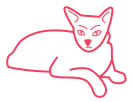 Cat
Cat
|
Risk Manager / Cynic | Need for agency | Need for Competence |
 Puppy
Puppy
|
Enthusiast | Need for Competence | |
 Owl
Owl
|
Process Master | Need for Agency | |
 Rabbit
|
Facilitator | Need for Competence |
Animal Pairs by Primary Need
Each SDT need is the primary driver for two animals. The animals that share a primary need differ in their secondary need, giving each a distinct character within the same motivational family.
Competence
The need to feel effective and capable of producing desired outcomes.
Bear (+ Agency) &
Rabbit (+ Relatedness)
Relatedness
The need to feel connected to others and to experience caring relationships.
Wolf (+ Agency) &
Puppy (+ Competence)
Agency
The need to feel in control of one's own behaviour and choices.
Cat (+ Competence) &
Owl (+ Relatedness)
Why SDT?
Self-Determination Theory provides a unified framework for understanding both individual motivation and group health. The primary/secondary need combination gives each animal its unique character. A Bear (Competence/Agency) and a Rabbit (Competence/Relatedness) are both competence-driven, but they express it very differently because of their secondary need.
At the group level, when all three SDT dimensions are covered, the team has competence (Bear + Rabbit driving quality), relatedness (Wolf + Puppy maintaining connection), and agency (Cat + Owl ensuring independent thinking and process). This makes the model both individually diagnostic ("what drives you?") and structurally diagnostic ("what does this group need?").
Related Work
The Six-Animal Model was originally informed by McClelland's Theory of Needs (1961), which identifies three motivational drives: Achievement, Affiliation, and Power. SDT's Competence, Relatedness, and Agency map closely to these constructs while being grounded in a broader empirical base spanning intrinsic motivation, well-being, and optimal functioning. The shift to SDT provides a richer theoretical foundation and aligns the model with contemporary motivational research.
References
- McClelland, D. C. (1961). The Achieving Society. Van Nostrand.
- McClelland, D. C. (1987). Human Motivation. Cambridge University Press.
- Deci, E. L., & Ryan, R. M. (1985). Intrinsic Motivation and Self-Determination in Human Behavior. Plenum Press.
- Ryan, R. M., & Deci, E. L. (2000). Self-determination theory and the facilitation of intrinsic motivation, social development, and well-being. American Psychologist, 55(1), 68-78.
- Belbin, R. M. (2010). Team Roles at Work (2nd ed.). Butterworth-Heinemann.
- Tuckman, B. W. (1965). Developmental sequence in small groups. Psychological Bulletin, 63(6), 384-399.
- Edmondson, A. (1999). Psychological safety and learning behavior in work teams. Administrative Science Quarterly, 44(2), 350-383.