The Six-Animal Model
A practical toolkit for better teamwork
The Six-Animal Model doesn't label who you are — it gives your team a shared language for talking about what you need from each other. By mapping group roles to six animal archetypes, it makes team dynamics visible, learnable, and actionable.
See the Model in Action
A short introduction to the Six-Animal Model and how it reveals group dynamics.
Key Insights
The Six-Animal Model is not a personality test. It is a communication toolkit designed to help teams work better together.
Tools, Not Labels
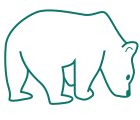
The model doesn't tell you who you are. It gives you and your team a shared vocabulary for talking about the roles people play right now, in this group, on this task. Saying "we need more Bear energy" is easier and safer than saying "you need to lead better".
Behaviours You Can Learn
No one is locked into a single animal. The model shows that group roles are behaviours, not fixed traits — and behaviours can be developed. You can learn to step into a role your team needs, even if it doesn't come naturally.
Make Space for Others
Effective teams don't just fill roles — they create room for every member to contribute. The model encourages people to recognise when they're dominating a function and to step back so that others can step up.
Every Style Has Value
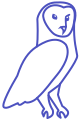
The cautious Owl, the independent Cat, the enthusiastic Puppy — every way of thinking serves a vital function. The model validates different approaches and shows why teams fail when any perspective is missing or dismissed.
Psychologically Grounded
The Six-Animal Model is built on Self-Determination Theory, one of the most well-established frameworks in motivational psychology.
Competence
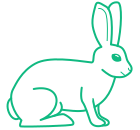
The need to feel effective and capable. Bear and Rabbit are driven primarily by competence -- they focus on quality, mastery, and getting things done right.
Relatedness
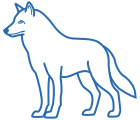
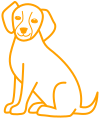
The need to feel connected to others. Wolf and Puppy are driven primarily by relatedness -- they focus on inclusion, harmony, and interpersonal connection within the group.
Agency
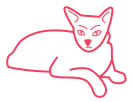
The need to feel in control of one's own choices. Cat and Owl are driven primarily by agency -- they focus on independent thinking, risk assessment, and self-governed process.
What Happens When a Role Is Missing?
Every role serves a critical function. Remove one and the group suffers in predictable ways.
No Bear?
Without a Bear, the group lacks direction.
No Wolf?
Without a Wolf, individuals work in silos.
No Cat?
Without a Cat, risks go unidentified.
No Puppy?
Without a Puppy, morale drops.
No Owl?
Without an Owl, scope creep is rampant.
No Rabbit?
Without a Rabbit, resources are unavailable when needed.
Want to use this in your organisation?
Dr McCallum delivers workshops, presentations, and consultations on the Six-Animal Model for teams, classes, and organisations. The model has been used successfully in MBA programmes, software engineering courses, game development teams, and professional workshops.