Group Diagnosis
Start with the problem, not the people. When a group is struggling, name the symptom first — then ask whether it comes from outside the team, or from a missing, dominant, or duplicated role inside it. The Six-Animal Model is a lens for the second kind of failure, and a way to talk about it without blame.
First, rule out external causes
Not every struggling group has a communication problem. Many teams fail for reasons that have nothing to do with how they talk to each other. Before reaching for the animal model, check whether the real cause is external to the group:
- Not enough time — deadlines or scope imposed from outside that no team could meet, however well it communicated.
- Not enough resources — missing budget, tools, access, people, or information the group simply does not have.
- A toxic environment outside the group — organisational politics, blame culture, conflicting incentives, or pressure from above that poisons the team from the outside in.
- External dependencies and shocks — blocked waiting on another team or approval; reorgs, turnover, or events outside anyone's control.
This model does not fix those problems. If the cause is external, the fix is renegotiating constraints, securing resources, or escalating — not rearranging roles. The Six-Animal Model focuses on one thing: communication failures within the group. Once you're confident the cause is internal, the rest of this page helps you find which animal to support — and what to do.
Common group problems — and what they signal
Recognise the symptom, then read the likely internal cause: a role that is missing, one that is dominant, or more than one of the same. Each links to an established framework that describes the same failure.
The group has no direction
Goals keep shifting, discussions circle, nobody decides, and work fragments into personal agendas.
Everyone agrees too quickly
No one challenges the plan, dissent feels unwelcome, and bad ideas sail through unexamined until they fail in reality.
Every idea gets shot down
Criticism dominates, energy drains away, people stop suggesting things, and nothing ever ships.
Nobody actually disagrees — but nobody's happy
The team agrees to a course no individual wants, because each assumes everyone else is on board. Polite consensus, quiet resentment.
Nothing gets finished
Meetings overrun, scope creeps, the same decisions are reopened, deadlines slip, and tasks fall through the cracks.
A few people do all the work
Others coast, contributions are uneven, and quieter members quietly check out without anyone noticing.
Conflict is avoided until it explodes
Tensions go unspoken, people work around each other, and small frictions harden into factions.
Low morale and a negativity spiral
People dread meetings, ideas are dismissed, and the emotional tone keeps sliding downward.
Endlessly blocked and under-resourced
The team waits on tools, access, or other people; practical logistics fall to no one; it feels cut off from support.
Too many chiefs
Several people compete to lead, visions clash, decisions are made and unmade, and execution descends into a power struggle.
Process over purpose
The team is busy and organised but loses the plot — rituals, templates and status updates crowd out the actual goal.
No trust, no candour
People guard their reputations, hide mistakes, and won't commit to decisions they privately doubt — so accountability evaporates.
Three ways the line-up goes wrong
Once you've ruled out external causes, internal dysfunction almost always traces to one of three faults in the mix of roles.
A needed function has no one performing it. The work it does simply doesn't happen, and the gap shows up as a predictable symptom.
One role drowns out the others. Its strength becomes the team's weakness, suppressing the balance the other animals provide.
Two or more people play the same role. They compete for the same space while other functions go uncovered.
When a role is missing
Each animal, when absent, produces its own signature failure. Diagnose by the symptom; then support that animal — ask someone to step into the function and back them with these moves.
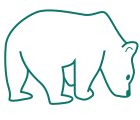
When There Is No Bear
Visionary / Leader — "Holds the vision"
Without a Bear, the group lacks direction. Ideas fragment with no unifying vision. No one steps up to make decisions, leading to paralysis and drift. The project loses momentum because there is no one driving toward achieving of the outcome.
How to support the Bear
- Ask one person to write the goal in a single sentence and restate it at the start of every meeting.
- Give them explicit authority to make the tie-breaking call when the group stalls.
- Use a “back to the vision” check: does this discussion actually serve the goal?
- Close open loops with a clear decision and owner before moving on.
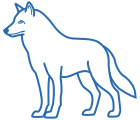
When There Is No Wolf
Manager — "Keeps the group together"
Without a Wolf, individuals work in silos. Some members disengage because no one checks whether they are included. Communication breaks down, cliques form, and the group fragments into disconnected sub-teams.
How to support the Wolf
- Open with a quick round-the-table check-in so everyone speaks early.
- Invite quieter members by name; don't let the loudest voice set the agenda.
- Name tension out loud and mediate it, rather than smoothing it over.
- Confirm shared buy-in: “can everyone live with this?” before you proceed.
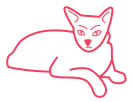
When There Is No Cat
Risk Manager / Cynic — "Wary of obstacles to success"
Without a Cat, risks go unidentified. Problems emerge late when they are expensive to fix. The group suffers from groupthink and overconfidence. Quality suffers because no one asks the hard questions.
How to support the Cat
- Explicitly invite “what could go wrong?” at each decision — treat it as a job, not an attack.
- Keep a visible risk register so concerns are tracked, not lost.
- Run a quick pre-mortem before committing to anything big.
- Publicly thank the person who raises the awkward concern — protect the role.
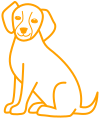
When There Is No Puppy
Enthusiast — "Happy, smiley, positive, eager"
Without a Puppy, morale drops. Creative ideas get dismissed too quickly by critical voices. A negativity spiral develops where people stop contributing because they expect rejection. The group loses energy and enthusiasm.
How to support the Puppy
- Start by celebrating progress and naming specific good contributions.
- Ask someone to find the “yes, and” in an idea before it gets critiqued.
- Watch the encouragement-to-criticism ratio in the room.
- Keep energy up in long sessions with breaks, small wins, and momentum.
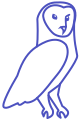
When There Is No Owl
Process Master — "Makes sure things move forward"
Without an Owl, scope creep is rampant. Meetings overrun with no outcomes. Tasks are forgotten because no one tracks them. There is no accountability, and the group revisits the same decisions repeatedly without resolution.
How to support the Owl
- Put an agenda and a timebox on every meeting.
- Capture decisions and action items with an owner and a date.
- Appoint someone to say “let's decide this now” and “let's move on.”
- Track tasks somewhere visible and review them at the next meeting.
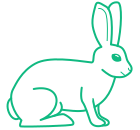
When There Is No Rabbit
Facilitator — "Resourceful, helpful, communicator"
Without a Rabbit, resources are unavailable when needed. External dependencies go unmanaged, creating bottlenecks. The group is isolated from management and support structures. Practical logistics fall through the cracks.
How to support the Rabbit
- Make one person responsible for unblocking the team — tools, access, information.
- List external dependencies early and assign someone to chase each one.
- “Take it offline” for side-quests so the meeting keeps moving.
- Liaise with management and other teams proactively, before you're blocked.
When a role is dominant
Each animal's gift, taken too far, becomes the team's problem.
The fix for a dominant role is rarely to silence it — it's to support the animal that counterbalances it.
Bear dominates
Vision turns autocratic. Others stop contributing because the direction is already decided; the team becomes an audience.
Support → the Wolf (bring others back in) and Owl (turn vision into shared steps).
Wolf dominates
Harmony over honesty. Conflict is smoothed over, hard decisions are deferred, and the team is "nice" but stalled.
Support → the Cat (allow honest disagreement) and Bear (force a decision).
Cat dominates
Critique without balance. Every idea is shot down, optimism is punished, and the group becomes paralysed and risk-averse.
Support → the Puppy (rebuild energy) and Bear (commit and move).
Puppy dominates
Toxic positivity. Real concerns go unspoken, scrutiny feels rude, and the team commits to plans nobody pressure-tested.
Support → the Cat (make “what could go wrong?” welcome).
Owl dominates
Process for its own sake. Bureaucracy and ceremony crowd out the goal; form beats substance.
Support → the Bear (keep the purpose above the process).
Rabbit dominates
Motion mistaken for progress. Endless fetching, deferring, and "taking it offline" keeps everyone busy but moves nothing forward.
Support → the Bear and Owl (refocus motion on the outcome).
When there's more than one
Duplicated roles compete for the same space while other functions stay empty.
The "All Bear" team
Everyone wants to lead. Too many chiefs, no structure: decisions are made but never executed because no one manages process (Owl), tracks resources (Rabbit), or holds the group together (Wolf). Risk goes unseen and morale suffers.
The "Two Cats" team
A second critic amplifies the first. Cynicism compounds, nothing is ever good enough to approve, and the Puppy's energy is extinguished. The team confuses scepticism with rigour.
The "All Puppy" team
Boundless enthusiasm, no grounding. Everyone cheers; no one checks. The team is a joy to be in and a disaster to deliver with — the classic setup for the Abilene Paradox.
The "Competing Owls" team
Two process owners fight over whose system wins. Energy goes into meta-work — tools, templates, and turf — instead of the work itself.
How this maps to established frameworks
Decades of research describe how groups and their communication break down. The Six-Animal Model isn't a replacement — it's a shared, blame-free vocabulary that connects these ideas to who needs to do what next.
Tuckman—Forming, Storming, Norming, Performing
Groups develop through predictable stages, and many get stuck in "storming" (conflict) or stall at "norming" (comfortable but not yet productive). In animal terms, storming is often a missing Bear or competing Bears; getting to performing usually needs the Owl and Wolf.
Tuckman's stages of group development →Lencioni—The Five Dysfunctions of a Team
Absence of trust → fear of conflict → lack of commitment → avoidance of accountability → inattention to results. The base layers map closely to a missing Wolf (trust, cohesion) and a missing Cat (healthy conflict); the top layers to a missing Owl and Bear (accountability and results).
The Table Group: Five Dysfunctions →Janis—Groupthink
Cohesive groups suppress dissent to preserve harmony, producing overconfident, poorly examined decisions. This is the textbook symptom of a missing or silenced Cat — and a reason the Cat role must be actively protected.
Groupthink →Edmondson & Google—Psychological Safety (Project Aristotle)
Google's research found the top predictor of team effectiveness was psychological safety: the shared belief that it's safe to speak up. A dominant Cat or Bear destroys it; the Puppy and Wolf rebuild it. The model's "diagnose the role, not the person" stance is a practical safety device.
Google re:Work — team effectiveness → · Psychological safety →Harvey—The Abilene Paradox
A group collectively chooses something no individual member wants, because everyone mismanages agreement and stays silent. It signals a dominant Puppy/Wolf (harmony) with no Cat to voice the obvious objection.
The Abilene paradox →Social Loafing & the Ringelmann Effect
Individual effort tends to drop as group size grows, especially when contributions aren't visible. The counter is the Wolf (inclusion, making everyone seen) plus the Owl (clear, tracked tasks).
Social loafing → · Ringelmann effect →Thomas–Kilmann—Conflict Modes
Five ways people handle conflict (competing, collaborating, compromising, avoiding, accommodating). Teams that default to avoiding need a Wolf to mediate and a Cat to surface the issue; teams that default to competing have too many Bears.
Thomas–Kilmann Conflict Mode Instrument →Belbin—Team Roles
The closest cousin to this model: nine behavioural roles a balanced team needs, where gaps and overlaps cause dysfunction. The Six-Animal Model trades Belbin's granularity for a memorable, motivation-based set of six tied to needs for Competence, Relatedness, and Agency.
Belbin Team Roles →Steiner & Brooks—Process Loss
A group's actual output = potential output − process losses (coordination and motivation overhead). Adding people can even slow a late project (Brooks's law). The Owl exists to minimise coordination loss; the Wolf to minimise motivation loss.
Process loss → · Brooks's law →Karpman—The Drama Triangle
Dysfunctional groups fall into Persecutor–Victim–Rescuer roles. A dominant Cat can slide into Persecutor and a dominant Puppy/Wolf into Rescuer; naming functions instead of casting characters helps the team step out of the triangle.
Karpman drama triangle →Putting it together
A practical sequence for diagnosing and fixing a struggling group.
- Rule out external causes. Is the problem really constraints, resources, mandate, or dependencies? If so, fix those first — roles won't help.
- Name the symptom. Describe what's actually going wrong, using the common-problems list above.
- Read the fault. Is a role missing, dominant, or duplicated? Map the symptom to the animal function behind it.
- Diagnose, don't blame. Ask "which function is missing?" not "who is failing?" — this keeps the group psychologically safe.
- Redistribute or recruit. Fill the gap, rebalance a dominant role, or split duplicated ones — using the multi-classing compatibility rules.
- Review and iterate. Observe again. Diagnosis is continuous, not a one-time verdict.
Need Help Diagnosing Your Team?
Dr McCallum offers workshops and consultations to help teams identify their missing, dominant, and duplicated roles and improve group dynamics using the Six-Animal Model.